Dropdown Menu

Showing posts with label Homeopathy For Children. Show all posts

Sep 6, 2013

A Case of Allergic Bronchitis

                                       
                                      A Case of Allergic Bronchitis

© 2013 Dr Vandana Patni 

Presented By
Dr Vandana Patni


A 14 year old girl presented with recurrent attacks of bronchitis with allergic rhinitis. Nose obstructed especially at night. Dry cough at night which wakes her. Attacks of difficult respiration which are further aggravated by walking and ameliorated by bending head forward. Wheezing during expiration. Asthmatic attacks precipitated by cold drinks and strong odors. Feels better by sitting. Have multiple freckles on the face.

All these complaints are occurring once or twice a month from childhood. Taking anti-allergic tablets and inhalers continuously but whenever she has an asthmatic attack, she has to take some antispasmodic drugs for bronchial spasm and sometimes rush for nebulization.

May 16, 2013

13 rubrics are chosen and repertorized in Radar.

Rubrics selected

NOSE - OBSTRUCTION
NOSE - OBSTRUCTION - night
NOSE - SMELL - acute
FACE - FRECKLES
RESPIRATION - DIFFICULT
RESPIRATION - DIFFICULT - bending - head - forward - amel.
RESPIRATION - DIFFICULT - walking
RESPIRATION - WHEEZING - expiration, during
COUGH - DRY
COUGH - NIGHT
COUGH - NIGHT - waking from the cough
GENERALS - FOOD and DRINKS - cold drink, cold water - agg.
GENERALS - SITTING - amel.


Medicines chart

Sep 13/31, Calc 11/25, Puls 11/24, Kali Carb 11/23, Sil 11/22.

Prescription:-

Sepia 200   3 Doses prescribed to take half hourly. Sac lac twice a day for a week.

May 23, 2013

Chest clear. Asthmatic respiration relieved. No cough. No obstruction of nose.

Prescription:-

Sac Lac for fifteen days.

June 8, 2013

No symptom and sign is detected. No complaint.

Prescription:-

Sac Lac for fifteen days.

June 29, 2013

Mild difficulty of respiration and nasal obstruction reported after exposure to dust. But symptoms are very mild as comparison to earlier attacks.

Prescription:-

Sepia 200  3 doses prescribed again with Sac Lac for fifteen days.

July 20, 2013

All the complaints were relieved on same day on june 29. No further nasal or respiratory symptoms.

Prescription:-

Sac Lac prescribed and advised to consult after a month.

August 20, 2013

No complaint.

Prescription:-

Sac Lac for fifteen days.

September 6, 2013

No complaint.

Since May 16, 2013 only one mild attack occurred on June 29. Earlier, attacks was occurring once or twice a month.

Prescription:-


Medicines discontinued and advised to contact on any discomfort.  

****************************

Online Consultation Available

Dr Vandana Patni
Dr R S Mann

Consultant Homeopathic Physician

Contact: 9897271337

****************************

Aug 12, 2011

A CASE OF PERTUSIS OR WHOOPING COUGH


 A Case of PERTUSIS Or WHOOPING COUGH  

       Presented By Dr UdayMani Kaushik
   
In a  8 months old child treated (& cured) with homeopathy.


It is a good example of case taking in infants.

PERTUSSIS (WHOOPING COUGH)


Pertussis, also known as whooping cough, is a Highly Contagious Disease
that is one of the leading causes of  vaccine-preventable deaths.

There Are 30–50 Million Cases Per Year, And About 300,000 Deaths Per Year (World Health Organization Data).
Worldwide whooping cough affects 48.5 million people yearly resulting in nearly 295,000 deaths. ( Wikipedia.org)

Most Deaths Occur In Children under One Year Of Age.


It is caused by certain species of the Bacterium Bordetella usually B. Pertussis, but some cases are caused by
  B. Parapertussis.


Pertussis was firstly described in 1578 by Guillaume de Baillou (1538-1616),
  B. Pertussis was isolated in pure culture in 1906 by Jules Bordet and Octave Gengou.


CHARACTERIZATION

Pertussis is characterized initially by mild respiratory infections symptoms such as Cough, sneezing, and runny nose (catarrhal stage). After one to two weeks the cough changes character, with paroxysms of coughing followed by an inspiratory "whooping" sound (paroxysmal stage).


Complications may be Pneumonia, Convulsions, Seizures, Encephalopathy or Earache. 


Conventional Treatment of Pertussis


Antibiotics

Most commonly used are erythromycin, azithromycin, clarithromycin.

History of The 8 month old male child


Previously treated with allopathic medicines And A Homoeopathic Physician With – Aconite , Drosera, Ant.T, Gels, Spongia , Justicea etc. without remarkable relief.


COUGH –


DRY SPASMODIC ,

WHOOPING COUGH

< EVENING

< NIGHT

On auscultation there were deep crepitation and wheezing sound all over chest.


On coughing his face used to become red and he wept after every spell of coughing.


At the pause of coughing he was making sound Continuously as GRUNTING 
as chest filled with sputum from throat.

But whenever some family member call him for diverting his attention ,he used to smile with STARING and fix his eyes just as saying his inability.


But not to offer his hands to come on lap his sound of grunting discontinue that time.


OBSERVATIONS


Child was lying dull on arms of his mother with fixed eyes.

He was weeping in a very low tone which ended with SHRIEKING.
Whenever his mother touches him on back he used to weep.
He has left himself on the shoulder of mother and STARING HELPLESSLY as if nothing can make him all right.
His mother added that his grunting sound remains continue even in sleeping condition.
Sleep - very light , jerking in legs and arms on going to sleep.
Weeps in very low tone after passing stool (stool is loose although).


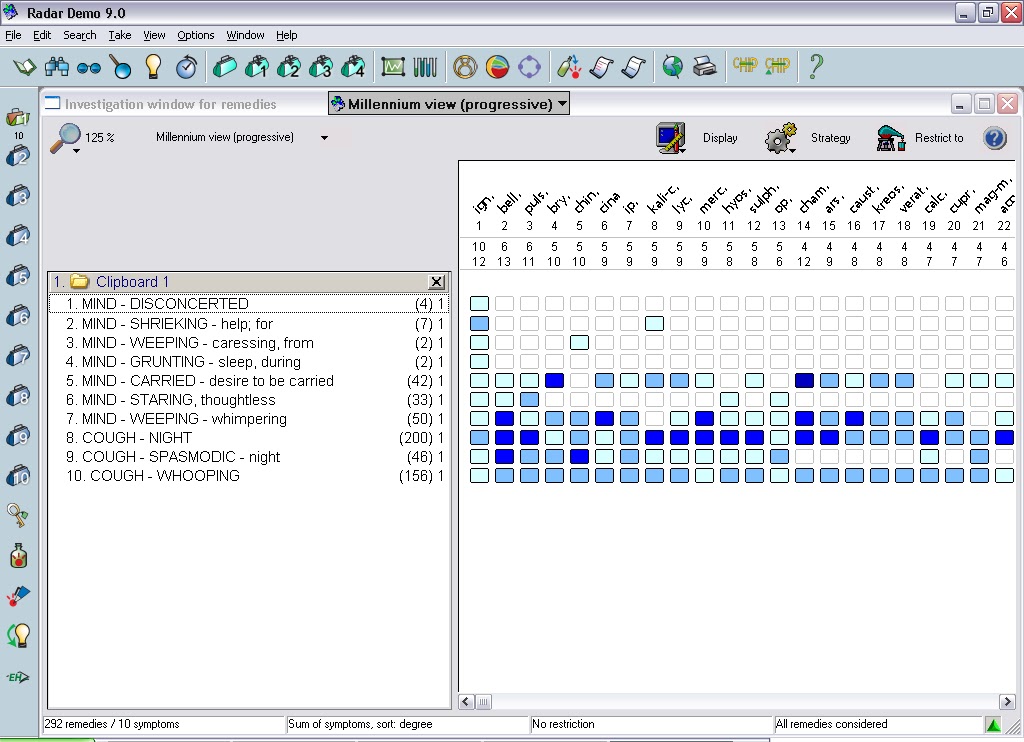
RUBRICS For REPERTORISATION

1. DISCONCERTED
2. SHRIEKING - HELP FOR
3 .WEEPING - CARESSING FROM
4. GRUNTING - SLEEP DURING
5 CARRIED - DESIRE TO BE CARRIED
6. STARING - THOUGHTLESS
7. WEEPING WHIMPERING

Other Supportive Rubrics


8. COUGH- AGG NIGHT
9. COUGH-CONVULSIVE, SPASMODIC , NIGHT
10. COUGH- WHOOPING 


Repertorisation Chart


PRESCRIPTION

IGNATIA  30  
 
3 Doses with in 15 minutes interval.
Followed by placebo.


RESULTS


COUGH - Much subsided same night.


Child slept well.


No whooping sound next morning.


Child was free from cough totally within 10 - 12 days. 


Jan 17, 2008

Sinusitis

Sinusitis: Sinus Infections
© Dr Vandana Patni 2008


Sinus infection, or sinusitis, is an inflammation of the sinuses and nasal passages. A sinus infection can cause a headache or pressure in the eyes, nose, cheek area, or on one side of the head. A person with a sinus infection may also have a cough, a fever, bad breath, and nasal congestion with thick nasal secretions. Sinusitis is categorized as acute (sudden onset) or chronic (long term, the most common type).
Structure of the sinuses (also called para-nasal sinuses): The human skull contains four major pairs of hollow air–filled–cavities called sinuses. These are connected to the space between the nostrils and the nasal passage. Sinuses help insulate the skull, reduce its weight, and allow the voice to resonate within it. The four major pairs of sinuses are the:

1. Frontal sinuses (in the forehead,under eyebrow)

2. Maxillary sinuses (behind the cheek bones)

3. Ethmoid sinuses (between the eyes)

4. Sphenoid sinuses (behind the eyes)

The sinuses provide defenses against bacteria (germs). If a disruption occurs that affects the normal host defenses inside the sinuses, those defenses may allow bacteria, which are normally present in the nasal passages, to enter any of the sinuses. Once the bacteria get entry ,they stick to the lining cells and cause a sinus infection.

Acute sinusitis usually lasts less than eight weeks or occurs no more than three times per year with each episode lasting no longer than 10 days. Successful treatment counteracts damage done to the mucous lining of the sinuses and surrounding bone of the skull.

Chronic sinusitis lasts longer than eight weeks or occurs more than four times per year with symptoms usually lasting more than twenty days.

The sinuses are covered with a mucus layer and cells that contain little hairs on their surfaces called cilia. These help trap and propel bacteria and pollutants outward. Para-nasal sinuses are connected to nasal cavities.

Causes of Sinus Infection

Acute sinusitis usually follows a viral infection in the upper respiratory tract, but allergens (allergy–causing substances) and pollutants may also trigger acute sinusitis. A viral infection causes damage to the cells of the sinus lining, which leads to inflammation. The lining thickens with fluid that obstructs the nasal passage. This passage connects to the sinuses. The obstruction disrupts the process that removes bacteria normally present in the nasal passages, and the bacteria begin to multiply and invade the lining of the sinus. This causes the symptoms of sinus infection. Allergens and pollutants produce a similar effect.

Bacteria that normally cause acute sinusitis are Streptococcus pneumoniae, Haemophilus influenza, and Moraxella catarrhalis. These microorganisms, along with Staphylococcus aureus and anaerobes (bacteria that live without oxygen), are involved in chronic sinusitis.

Fungi are also becoming an increasing cause of chronic sinusitis, especially in people with diseases that weaken the immune system, such as AIDS, leukemia, and diabetes.


Symptoms of Sinus Infection

Signs and symptoms of sinus infections depend upon which sinuses are affected and whether the sinus infection is acute or chronic.

Acute sinusitis:

A. Ethmoid sinusitis (behind the eyes)

  • Nasal congestion with discharge or postnasal drip (mucus drips down the throat behind the nose)
  • Pain or pressure around the inner corner of the eye or down one side of the nose
  • Headache in the temple or surrounding the eye
  • Pain or pressure symptoms worse when coughing, straining, or lying on the back and better when the head is upright
  • Fever


B. Maxillary sinusitis (behind the cheek bones)

  • Pain across the cheekbone, under or around the eye, or around the upper teet
  • Pain or pressure on one side or both
  • Tender, red, or swollen cheekbone
  • Pain and pressure symptoms worse with the head upright and bending forward and better when reclining
  • Nasal discharge or postnasal drip
  • Fever

C. Frontal sinusitis (behind forehead, one or both sides)

  • Severe headaches in the forehead
  • Fever
  • Pain worse when reclining and better with the head upright
  • Nasal discharge or postnasal drip

D. Sphenoid sinusitis (behind the eyes)

  • Deep headache with pain behind and on top of the head, across the forehead, and behind the eye
  • Fever
  • Pain worse when lying on the back or bending forward
  • Double vision or vision disturbances if pressure extends into the brain
  • Nasal discharge or postnasal drip

Chronic sinusitis:

A. Ethmoid sinusitis

  • Chronic nasal discharge, obstruction, and low–grade discomfort across the bridge of the nose
  • Pain worse in the late morning or when wearing glasses
  • Chronic sore throat and bad breath
  • Usually recurs in other sinuses

B. Maxillary sinusitis

  • Discomfort or pressure below the eye
  • Chronic toothache
  • Pain possibly worse with colds, flu, or allergies
  • Increased discomfort throughout the day with increased cough at night

C.Frontal sinusitis

  • Persistent, low–grade headache in the forehead
  • History of trauma or damage to the sinus area
D.Sphenoid sinusitis
  • Low–grade general headache common

Exams and Tests

The diagnosis of a sinus infection is usually made based on a thorough medical history assessment and a physical examination. Adequately distinguishing sinusitis from a simple upper respiratory infection or a common cold is important.

Sinusitis is often caused by bacteria and viruses .Upper respiratory infections and colds are viral illnesses. Proper diagnosis of these potentially similar conditions prevents confusion as to which medications should be given. Over treating viral infections with antibiotics can be dangerous.

A. X-Ray PNS(Para Nasal Sinuses) may be helpful in diagnosis of sinus infections.But it is not con formative among bacterial or viral cause of sinusitis and sometimes X-Ray study may miss the infection.

B. CT scan: In most cases, diagnosing acute sinusitis requires no tests. When testing is needed, the CT scan can clearly depict all of the para-nasal sinuses, the nasal passages, and the surrounding structures.
Mucosal thickening can occur in people without symptoms of sinusitis. Therefore, CT scan findings must be correlated with a person's symptoms and physical examination findings to diagnose a sinus infection.

C. Ultrasound: Another noninvasive diagnostic tool is ultrasound. The procedure is fast, reliable, and less expensive than a CT scan. However, the results are not as detailed as those from a CT scan. 


D. Nasopharyngoscopy: Direct viewing of Nasal and pharyngeal cavity.


E.Culture and Sensitivity : Doctor may drain the affected sinus to test for organisms. This is a more invasive test than those already mentioned. During this procedure, a doctor inserts a needle into the sinus through skin (or gum) and bone in an attempt to withdraw fluid, which can be sent to the lab for culture. Any present bacteria can be identified . Usually this procedure does not needs.
Sinus Infection Treatment

Self–Care

A.Promote drainage

  • Drink plenty of water and hydrating beverages. Hot tea is often recommended.
  • Inhale steam two to four times per day by leaning over a bowl of boiling hot water (not while the water is on the stove) or using a steam vaporizer with a towel over the head and bowl to prevent the escape of the steam. Inhale the steam for about 10 minutes
B.Relieve pain: Pain medication such as ibuprofen , aspirin, and acetaminophen ( reduce pain and inflammation. These medications help to open the airways by reducing swelling.

Medical Treatment

The main goals in treating a sinus infection or sinusitis involve reducing the swelling or inflammation in the nasal passages and sinuses, eliminating the infection, promoting drainage from the sinuses.

Medications

1.Decongestants -help to reduce airway obstruction and are important in the initial treatment to alleviate symptoms.
2.Nasal sprays -work fastly—within one to three minutes. However, these agents should not be used for more than three days because they become less effective and developed dependency on it.
3. Oral Decongestants
Both nasal and oral decongestants have side effects, including general stimulation causing increased heart rate and blood pressure, insomnia, nervousness, anxiety, tremor, dry mouth, blurry vision, and headache. They may also cause an inability to urinate. Therefore, persons with a history of cardiac disease, high blood pressure, anxiety, or urinary problems should consult a physician before using decongestants.
4. Antibiotics: Broad spectrum antibiotics may be necessary for Bacterial infection.
5.Anti-allergic drugs may be prescribed to you.
6.Steroids: Intra-nasal steroids may be needed in cases of recurrent attacks of acute or chronic sinusitis.

Surgery

Surgery may be needed to remove complications of sinusitis and to remove obstruction

A.The surgery is performed endoscopically using the same fiberoptic nasopharyngoscope used to make the diagnosis.
B. During the surgery, nasal polyps can also be removed, and a crooked nasal septum can be straightened, leading to improved airflow.

Homeopathic Treatment

Homeopathy is well known for cases of Sinusitis,Allergy and recurrent infections. Homeopathy cures permanently Acute,Chronic and Allergic sinusitis. Old patients needs long term therapy to cure permanently. Homeopathy has more then 150 medicines for Allergy,Acute and Chronic Sinusitis. Children and young age persons are more vulnerable to infections of nasal cavity and sinuses. Homeopathy medicines are prescribed on basis of individuality of patient, modalities, symptoms, temperament, personality traits, mental attitudes and behavior patterns.