Dropdown Menu

Showing posts with label Homeopathic Philosophy. Show all posts

Oct 3, 2014

Corn and Callous: Few cases of Homeopathic Cure

© 2014 Dr Ravindra S Mann


Corns and Callouses are hard, thick growth of skin which are developed due to frequent friction, rubbing and pressure on the skin.

Corns and Callouses form on the sole, toes and may make walking painful.

Though they are discussed together but they are very different from each other.

It is supposed that corns and callouses disappear gradually when the pressure and friction stopped, but this does not happen in every case. Corn pad, salicylic acid remedies, corn plasters, corn paints, removing the hard skin surgically and many other options which are used, fails many a times and patients suffer it as earlier.


Homeopathic Approach:

Homeopathy has 131 medicines to treat corns and 48 medicines to treat callosities.

Homeopathy treats patient with a different perspective. Corns and callouses are not just a local disorder but they are part of a pathological process running in patient. Therefore, we need to stop the whole process to get rid of these local manifestations of that pathological process. According to homeopathy there are no local diseases but only local manifestations of general pathological processes.

 And as a homeopath we condemn the modern medicine for its approach towards various disorders, as local diseases. The so called local diseases are actually the local outward manifestations of general pathological processes which are running in a sick person. This difference of approach decides the way of treating these disorders either as a local manifestation or as a local disease.

Treating a disorder as a local disease either in modern medicine or in some other systems of medicines, simply a method of suppression. Homeopathy treats these disorders as a part of whole sickness. Main approach of treating local diseases in modern medicine is same like treating corns and callouses.

As per homeopathic approach, local manifestations are actually the human system’s defense methodology. Human system tries to throw out the diseases and try to nullify the effects of disease process running in a human system.

The every attempt to treat the local outward manifestations by suppressing as treating by creams, lotions, surgically removing, using corn paints or other means in other local disorders, actually undermine the human defense system. Local measures to treat the local manifestations of diseases are, in real, simply helping the diseases to increase further. The real method to cure is to treat homeopathically.

Case 1:

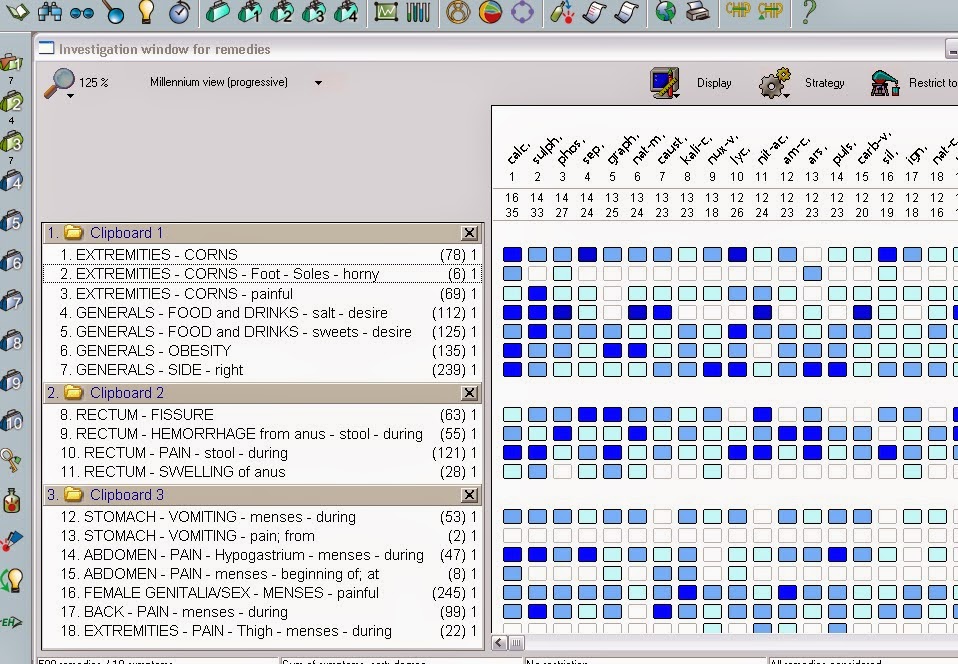
A 17 yrs old, very obese girl presented multiple, painful corns in right sole for more than a year. Has tried all the methods of treatment before consulting homeopathy. Has many other complaints too. She has fissures in anus, hemorrhage during stool, and swelling in anus. Menses very painful, pain in hypogastrium(lower abdomen), back and thighs during menses, vomiting during menses due to pain. Pain in abdomen starts at beginning of menses.  Desires to eat salty and sweet food very much.

March 29, 2013

Repertorization in Radar


First prescription

Calcarea Carb 200   3 Doses prescribed on interval of two hours with sac lac for two weeks.

May 2, 2013

Patient returned back after gap of two more weeks. Much better in corns and all other complaints.

Prescription

Calcarea Carb 200  3 doses advised to take on May 12, 2013, 45 days after taking first dose of Calcarea.

June 6, 2013

Patient is much much better in her complaints. Corns are very much reduced.

Sac lac is prescribed for two weeks.

July 29, 2013

Corns are cured. Soles are clean and soft. All other complaints are reduced much more.


Case 2:

A 39 yrs old female presented corns and callosities on her left sole and toes, which are very painful on walking and even on touch. Has facing this problem for last 7-8 months tried many means but failed.

Patient is very sad, depressed, not caring her own family, very indifferent, very sensitive and feel offended easily, feel good when busy in her work and occupied. Feel comfortable when alone. Very hungry and emptiness in stomach does not ameliorate by eating.

July 8, 2014

Repertorization in Radar


First Prescription

Sepia 200  3 doses advised to take after every two hours on first day. Sac lac advised for next 15 days.

September 18, 2014

Patient come to consult for her son. She is very happy and pleased. Her corns disappeared in 10 days after taking Sepia 200.

Case 3:

A 27 yrs old girl presented with callosities and corns on right sole which are tender and painful respectively. She has a long history of these disorders, which were earlier improved itself. But now she is suffering from corns and callosities for more than 7-8 months.

Another complaints; are hair falling, premature graying of hairs, burning in urethra after urination, mild swelling on face and extremities and obesity.

March 20, 2012

Repertorization in Radar


First Prescription:

Lycopodium 200    3 doses are prescribed to take after one another with interval of 2 hours in between.

Sac lac prescribed for 15 days.


April 3, 2012

Burning urination stopped on 3rd day after medication started. All the corns and callosities are reduced very much, tenderness and pain gone.

Sac Lac prescribed for 15 days again.


April 27, 2012

All the corns and callosities gone. Soles are soft and on examination no trace of callous or corns are found. Further treatment for another disorders continued.


Case 4:

A 24 yrs old girl presented with very horny corns on both soles. She has got these corns recently, very first time. Corns are very painful on walking. No other accompanied symptoms or signs are present.

July 21, 2014

Repertorization in Radar


First Prescription

Antim Crud 200   3 doses prescribed with interval of 2 hours. Sac lac prescribed for a week.

August 2, 2014

Patient is very much better. No pain in corns on walking. Corns are getting soft. Sac lac is prescribed. Advised to consult after 15 days.

August 23, 2014

All the corns are gone. Soles are soft and looks natural.  


Case 5:

A 2 yrs old boy has corn in sole for 2 months. It is painful but most striking feature is the corn and surrounding area is dark yellow in colour.

November 22, 2013

Repertorization in Radar


First Prescription

Ferrum Pic 30    3 doses advised to take with interval of two hours in between.

Sac Lac prescribed for 15 days.

December 10, 2013

Corn reduced in size and surrounding area becomes soft. Yellow discoloration reduced to a marked extent.

Ferrum Pic 30   3 more doses prescribed as earlier with Sac lac for 15 days.

December 27, 2013

Corn is cured. Medicine discontinued.


Conclusion:

Corns and Callouses are curable by homeopathic medicines. Homeopathy offers safer and more effective method to treat these disorders. In homeopathic prescription, associated disorders are equally important in selecting the correct medicine for a local disorders (corns and callouses in this post).

May 5, 2014

होम्योपैथीः बहुत से रोग एक ही दवा


© Dr Ravinder S Mann 2014


होम्योपैथी के बहुत से फायदों में से एक सबसे महत्वपूर्ण ये है कि आप बहुत से अलग- अलग रोगों के लिये कम से कम या फिर सिर्फ एक ही दवा से ठीक हो सकते हैं. ये दावा आश्चर्यजनक या भ्रमाने वाला लग सकता है लेकिन यह तथ्यों पर आधारित है. इस दावे को थोङा खुलकर और कुछ मरीजों के वास्तविक केसों से समझते हैं.


40  वर्ष का यह रोगी मस्सों (Warts) के लिये दवा लेने आया जिनसे वह 5 वर्षों से पीङित था. लेकिन साथ ही वह बुरी तरह से  अवसाद (Depression and Anxiety) व अनिद्रा (Insomnia)से भी पीङित है और पिछले  8 वर्षों से अवसाद व नींद के लिये दवायें (Antidepressant and Sedatives) ले रहा था लेकिन इसके बावजूद उसके विभिन्न लक्षण रोजमर्रा के  जीवन में बाधा बन रहे थे उन सब दवाओं के बावजूद वह जीवन को आनंददायक ढंग से और पूर्णतया स्वस्थ होकर नहीं जी पा रहा था. और जैसा कि होम्योपैथी मानती है मानसिक रोग धीरे- धीरे शारीरिक रोगों को भी जन्म देते हैं यानि रोगों की उत्पत्ति मानसिक आयाम से शारीरिक आयाम की तरफ होती है

(Pshyco-somatic origin of diseases). यह रोगी 8 वर्षों से अवसाद से पीङित था और फिर 5 वर्ष पहले मस्से बनने लगे. किसी भी प्रकार के ईलाज ने उसके रोग और लक्षणों को राहत नहीं पहुँचाई.


यह रोगी एक Antacid, एक  Antidepressant, एक  Sedative और एक Antihypertensive रोज ले रहा था. और इसके बावजूद बीमारियों का ठीक होना तो दूर फौरी तौर पर लक्षणों को राहत भी नहीं थी. लेकिन होम्योपैथी ईलाज में आने के बाद उसके सभी लक्षणों को आधार बनाकर सिर्फ एक ही दवा (Aurum Met) दी गयी और रोगी के मस्से, अवसाद, अनिद्रा सभी ठीक हो गये. जिनके लिये ना तो अलग- अलग दवायें लेनी पङीं और ना ही 8 वर्ष तक या 5 वर्ष तक लगातार ईलाज लेने की जरूरत पङी.    


35 वर्षीय महिला 10 वर्षों से सिरदर्द से पीङित है. सिरदर्द ज्यादातर सिर के एक तरफ होते हैं जिन्हें माइग्रेन के रुप में डायग्नोस किया जाता है. लेकिन साथ ही यही महिला हाईपोथायरोडिज्म यानि थायराईड ग्रंथि द्वारा हार्मोन्स के कम स्रावण से पीङित है. साथ ही यूरिक एसिड का स्तर भी रक्त में सामान्य से अधिक है. उदासी, अनिद्रा, चिङचिङापन, क्रोधी स्वभाव भी रोजमर्रा के जीवन को प्रभावित कर रहा है. रोगिणी सिरदर्द के लिये दर्द निवारक गोलियाँ, थायराईड के लिये दवाई, यूरिक एसिड को कम करने के लिये दवाई ले रही है. अब अगर वह नींद, उदासी व क्रोध के लिये भी किसी चिकित्सक की राय ले तो इनके लिये भी अलग से दवायें लेनी होंगी.


लेकिन यही रोगी जब होम्योपैथी दवा लेना चाहता है तो इन सभी रोगों और लक्षणों के लिये सिर्फ एक ही होम्योपैथी दवा (Sepia) से ठीक हो जाता है.एक ही दवा सिरदर्द के साथ- साथ यूरिक एसिड के स्तर को भी ठीक करती है और थायराईड ग्रन्थी के काम में सुधार लाती है.


और यह होम्योपैथिक ईलाज भी हमेशा नहीं लेना पङता, बल्कि  कुछ सप्ताह या कुछ महीनों में ही इन वर्षों पुराने रोगों से छुटकारा पाया जा सकता है.


अब सवाल ये है कि ऐसा कैसे सम्भव है कि आप इतने अलग- अलग रोगों से पीङित हों और जिनके लिये आप अलग- अलग चिकित्सकों से ईलाज ले रहे हों, उन विभिन्न रोगों को कुछ या एक ही दवा से ठीक किया जा सके?


होम्योपैथी सभी बीमारियों को सायको-सोमैटिक स्तर से उत्प्न्न हुआ मानती है. दूसरा, होम्योपैथी की अवधारणा यह है कि किसी भी रोगी के अलग- अलग तंत्रों (Systems) में होने वाले विभिन्न रोग अलग- अलग लक्षणों के बावजूद मूल रुप से आपस में सम्बन्धित हैं. और किसी भी रोगी के सभी रोगों को एक ही ईकाई के रूप में देखा जाना चाहिये. यानि होम्योपैथी का रोगों के बारे में बुनियादी नजरिया अन्य चिकित्सा प्रणालियों से अलग है. होम्योपैथी की चिकित्सा के बारे में मूल अवधारणा यह है कि किसी भी रोगी के विभिन्न रोगों का ईलाज करने के बजाय उस रोगी का ईलाज किया जाये जिसे विभिन्न रोग हैं.


दूसरी ओर, होम्योपैथिक दवाओं के लक्षणों को जानने के लिये जानवरों पर नहीं बल्कि स्वस्थ मनुष्यों पर ही उनके प्रयोग किये गये हैं. इसके पीछे मूल अवधारणा और तर्क यह है कि जब दवाओं का प्रयोग मनुष्यों पर होना है तो हमें दवाओं के मनुष्यों पर प्रभाव की ठीक- ठीक जानकारी होनी चाहिये. यह ध्यान रहे कि दवायें मनुष्यों व अन्य जानवरों पर अलग- अलग प्रभाव डालती हैं. किसी दवा के, किसी जानवर पर होने वाले प्रभावों को आधार बनाकर, मनुष्यों पर उस दवा का इस्तेमाल नहीं होना चाहिये.


जब इन दवाओं का मनुष्यों पर शोध किया गया तो यह पाया गया कि प्रत्येक होम्योपैथिक दवा एक से ज्यादा तंत्रों को प्रभावित करती है और विभिन्न लक्षणों को पैदा करती है. इन सभी लक्षणों को एकत्रित किया गया और सूचीबद्ध किया गया.


अब किसी भी रोगी को वही होम्योपैथिक दवा दी जाती है जो उसके सभी लक्षणों से मेल खाती है. यानि एक रोगी जिसे सिरदर्द के साथ अनिद्रा, अवसाद के साथ भय, निराशा के साथ आत्महत्या करने के विचार आते हों उसे ठीक वही होम्योपैथिक दवा दी जायेगी जो स्वस्थ व्यक्तियों में शोध करते समय ठीक यही लक्षण प्रकट करती हो. इसलिये होम्योपैथिक ईलाज लेने में सबसे महत्त्वपूर्ण यह है कि यदि आप बहुत से अलग- अलग रोगों से पीङित हैं तो जरूरी नहीं कि आप अलग- अलग चिकित्सकों से ईलाज लें और बहुत सी दवायें खायें. आप होम्योपैथी चिकित्सा लें और आपका होम्योपैथ आपके सभी रोगों को ध्यान में रखकर एक ही प्रेसक्रिप्शन देगा और यही दवा आपके सभी रोगों का निदान भी करेगी.  

हमारी चिकित्सक टीम से परामर्श लेने के लिए यहाँ क्लिक करें.


Sep 25, 2013

The Importance Of A Single Symptom By Ad. Lippe


The Homoeopathic Physician
May, 1883

The Importance Of A Single Symptom

Ad. Lippe, M.D., Philadelphia

Edited By: Dr. Vandana Patni

The importance of a single symptom becomes apparent when we detect in a patient a single characteristic symptom corresponding with a single characteristic symptom observed in the proving of a drug. To illustrate this position I will, first, quote a case from my case-book in which an objective symptom indicated the truly specific remedy.

This case was one of very malignant “ship fever.” The patient had been sick nine days when I found him in the morning, lying on his back, perfectly unconscious; eyes wide open, glaring, and fixed on the ceiling, pupils dilated; cheeks red and hot; mouth wide open, lower jaw hanging down; tongue and lips dry, black, and cracked; picking of bed coverings; pulse 200. The pathological condition was most certainly approaching paralysis of the brain.

The unconsciousness in this case reminded me at first of Bell., Hyos., Mur.ac., Opium, Rhus, or Stram. The eyes indicated Bell., Hyos., Opium, or Stram. The tongue and lips of Arn., Ars., Hyos., Opium, or Stram. The hanging of the lower jaw of Ars., Lyc. Or Opium. Not being able to select a remedy, I further examined the patient and found that he has passed urine involuntarily all night, but this symptom again left me to choose between Arn., Ars., Bell., Hyos., or Rhus; but upon still further examination I found on the sheet of the patient a large deposit of red sand, resembling brick dust deposited from the urine involuntarily discharged. Here was the objective symptom characteristic of the case and of the remedy. I now concluded to give Lyc., therefore I dissolved six pellets of the 200th potency in half a tumbler full of water, and had a spoonful, every two hours, put into the open mouth of the unconscious patient. When I saw him again, at 2 P.M., I found him with his eyes and mouth firmly closed in a natural sleep and in a very heavy perspiration. He finally recovered fully, and enjoyed perfectly good health for many years.

In this case the single characteristic was a guide in the selection of the curative remedy, but not in the diagnosis of the disease. If this single symptom had been a guide in the diagnosis of the disease, it would not have been a guide in the selection of the curative remedy.

To illustrate further the position assumed that one single symptom is very important, let us refer to the frequently recurring symptom, “Sinking at the epigastrium.” This symptom standing alone and by itself is of no importance whatever, neither characterizing a remedy or any abnormal condition of the system. Whether caused by a disturbed condition of pneumo-gastric nerve, or of the uterus, or by nervous depression, the symptom by itself, or the supposed cause, will never assist us in finding the curative remedy.

As far as our observations have been able to enlighten us, this symptom has been successfully removed by the following medicines: Alumen, Ambra, Baryta, Digitalis, Ignatia, Kali Carb, Lobelia, Lycopodium, Petroleum, Oleander, Sepia, and Veratrum.

The important single symptom in this connection under Alumen is that the sinking sensation is aggravated after eating, while under Baryta it is relieved by eating. This symptom is on record in Hahnemann’s Chronic Diseases: “Sensation of weakness in the stomach, which disappears after eating.” The important single symptom under Ambra we find thus in Hahnemann’s Materia Medica Pura: “She must lie down on account of giddiness and a sensation of weakness in the stomach.”

Under Alumen and Baryta we find one conditional symptom, the aggravation and amelioration after eating. Under Ambra we find one concomitant and one conditional symptom, the combination of the sinking feeling with the condition of being obliged to lie down.

Digitalis has the characteristic symptom so often confirmed in practice and given by Hahnemann in his Materia Medica Pura: “A weakness of the stomach, as if the stomach were sinking away and as if life would vanish.” Later it was observed that this sensation of weakness generally occurred “after eating.”

Under Ignatia, we find in Hahnemann’s Materia Medica Pura: “A peculiar sensation of weakness in the upper abdomen and in the pit of stomach;” and “drawing and pinching in the lower abdomen, descending into the rectum like pressing, with qualmishness and sinking in the pit of the stomach and paleness of the face (after forty-eight hours, two days before menstruation).” And again: “Debility, as from weakness (sinking), around the pit of the stomach; he feels qualmish and must lie down.”  

Under Kali carb., we find in Hahnemann’s Chronic Diseases: “Pressure in the stomach with rumbling, sensation of emptiness and eructations.”

Under Laurocerasus, we find pain in the stomach, like fainting; feeling of weakness in the stomach.

Under Petroleum we find in Hahnemann’s Chronic Diseases: “Sensation of emptiness in stomach, as from fasting.”

Under Lobelia, we find: “Feeling of weakness of the stomach or in the pit of the stomach, extending through the whole chest.”

Under Oleander, we find in Hahnemann’s Materia Medica Pura: “Sensation of great emptiness in the pit of the stomach, with a fullness in the abdomen,” and it had been observed that this sensation of emptiness in pit of stomach has been relieved by drinking brandy, often accompanied by nausea.

Under Sepia, we find in Hahnemann’s Chronic Diseases: “Emptiness in the stomach (sensation of) with nausea as soon as she thinks of any food that might be offered to her.”

Under Veratrum, we find in Hahnemann’s Materia Medica Pura: “Sensation of weakness of the stomach, with an internal sensation of coldness in the region of the stomach and a light pressure.”

The importance of a single symptom in connection with this much perplexing sensation of “sinking at the epigastrium,” weakness at the pit of the stomach, is very obvious. We find that Alumen and Digitalis have an aggravation of this sensation after eating; that Baryta has an amelioration after eating; that under Oleander brandy relieves; that under Kali carb. is accompanied by eructations; that under Ignatia this sensation has appeared two days before menstruation, accompanied by pale face and qualmishness, which caused the patient to lie down; that under Sepia the sensation was increased by thinking of food. The sensation is strongest in the pit of the stomach under Digitalis, Ignatia, and Lobelia; under Digitalis the sensation is so intense that he feels as if life would vanish.

Many cases will met in practice in which these symptoms are present with the sensation of sinking at the epigastrium; yet, at times, other remedies will have to be looked for to find symptoms corresponding with the peculiar characteristic symptoms of the patient.

A single symptom is all-important if it is the characteristic of the medicine, corresponding with the characteristic symptom of the case to be treated. Inasmuch as we no longer treat diseases, or supposed diseases conditions giving rise to them, but as we treat patients, it is no longer our duty to find the single symptom as a guide in diagnosis. It is our task, however, to find the single characteristic symptom both of the patient and of the remedy.

If we first get a clear idea of what constitutes the characteristics of medicines, we involuntarily adapt ourselves to the easy finding of the characteristic symptoms of the patient. The characteristic symptoms of a medicine go through all its pathogenesis like a red streak. We find, for instance, that all the symptoms, Aconite is capable of producing in the human system, and therefore is able to cure, are accompanied by “Anxiety,” and differ in the restlessness which is caused by “anxiety” under Aconite from the restlessness which is caused by “anguish” under Arsenic. Aconite has no characteristic pains. The burning and stinging in internal organs, tearing in external parts, and tingling in (fingers, oesophagus, and back) external parts, Aconite has in common with many other drugs; if, for instance, a patient complains of tearing in external parts, as in acute rheumatism, yet lies perfectly quiet, afraid to move, and if compelled to move suffers much pain, no experienced physician could think of administering Aconite, simply because the accompanying fever indicates inflammatory disease, but he would give Bryonia, if the other symptoms also indicate it. On the contrary, if the patient is very anxious and restless. Not afraid to move, but tossing about, which he declares he cannot help, although it increases his pains, no one would give Bryonia, but Aconite, if otherwise indicated.

The “Anxiety” of Aconite may be termed a general characteristic, like the “anguish” of Arsenic or the constant aggravation of all the symptoms after sleeping under Lachesis, or the amelioration in open cold air under Pulsatilla; the amelioration the cold air alone being equally characteristic of Iodine, or the aggravation at 3 A. M. under Kali carb.

Besides these general characteristics which go through the whole remedy, we observe special characteristics as under Kali bichr. that all the mucous discharges are stringy, or under Phosphorus that the cough is aggravated in the cold air.

The single symptom, which becomes all-important in a case, may comprise the kind of pains experienced, as under Apis “the burning, stinging pains;” or it may comprise the locality, as wrist and ankle under Ruta; or the direction the pain or disease follows, as from right to left, below upward, from the inside outward, or vice versa; or the condition (of amelioration or aggravation),as in the amelioration from heat of Arsenic, the amelioration from cold of Iodine; or from concomitant symptoms, as the great, unquenchable thirst, the great desire to drink large quantities under Natr. mur. or again, the thirstlessness of Pulsatilla.

The single symptom becomes all-important in some well-known diseases, as, for instance, in whooping cough. **** Yet the true physician has first to choose the proper remedy, and then to administer it properly if he hopes to be successful in this, as well as all other diseases. The character and peculiarities of the cough alone do not indicate a remedy. it is indispensably necessary to inquire further, and first ascertain at what time of the day the cough is aggravated. What else aggravates the cough? What are the concomitant symptoms? What is the character of the expectoration?

And in this manner it will become apparent that as to time the Drosera aggravation is after midnight; that the cough returning every day at the same hour may indicate either Lycopodium or Sabadilla.

Under the conditional aggravations it will become apparent that if pressure on the larynx aggravates the cough, Cina will be indicated; or that if walking fast brings on or aggravates the attack, Sepia will cure; or that if hasty eating or drinking causes an attack, Silicea will cure; or, with regard to the expectoration, that if the great quantity of mucus which threatens to suffocate the patient is difficult to expectorate, and if raised at all is tough and stringy and hard to detach, etc., Coccus cacti is the remedy.

All these single symptoms become important and will enable the practitioner to select the curative remedy; the name of the disease never will, as no medicine has ever produced or can produce whooping cough, but only a cough similar to whooping cough. The cough produced by mephitis for instance, has been very similar to whooping cough, but was not whooping cough and can only cure in those cases where the concomitant symptoms correspond with mephitis – Am. Hom. Review, 1863.   


                            = = = = = * * * * * * * * = = = = =

This paper was written twenty years ago, and after that long lapse of time its author is more than ever convinced of the great importance of the single symptom. The single peculiar symptom, expressive, as it were, of the characteristic individuality of the sick and not necessarily belonging to the form of disease of which he suffers, if also characteristic of a proved drug – becomes very frequently a guiding symptom, will very often lead us to compare the symptoms of the sick with the symptoms of the drug presenting that guiding symptom, a remedy which probably escaped our notice without it, and if the similarity between the symptoms of the sick and the provings of the drug become apparent, then and then only has this single guiding symptom been profitably utilized. Later on it was claimed that this single symptom, when present both on the sick and in the provings, would absolutely demand recognition and was erroneously termed a key-note, and this erroneous interpretation of the importance of the single symptom opened the way for great and fatal abuses. And now for an illustration: We find, for instance, in that excellent work on Diphtheria by Dr. Gregg, a case of diphtheria cured by Lachnanthes. The indications for the use of Lachnanthes were – the stiff neck the patient had. A cure followed. The deduction from this observation of a cure would be that a stiff neck in diphtheria is a key-note for Lachnanthes in that disease. This is, of course, poor logic, and later experience illustrates it. In a case of diphtheria we lately published this very painful stiff neck was a very prominent symptom, and the clinical experiment has shown that another case of diphtheria where this stiff neck was present had been promptly cured by Lachnanthes, that in the stiff neck following not unfrequently diphtheria and scarlet fever Lachnanthes had very often cured it. In the case alluded to, all and every symptom of the patient suffering from diphtheria, also the stiff neck, were covered by Kali bichr., and the stiff neck was cured with the other very grave symptoms of diphtheria. Kali bichr. has probably never been given for wryneck before, and now if in a case of diphtheria this stiff neck occurs, we will have to take into consideration the similarity of the other symptoms of the patient, having this guiding symptom to make us compare Kali bichr. and Lachnanthes. Again, we find under Lachesis, as a very characteristic symptom, throat and cough symptoms worse after awaking. The clinical experiment demonstrates that Kali bichr. and Aralia have the same symptom, and we will now, knowing that this great aggravation after sleeping is not a key-note for Lachesis, not be easily disappointed when we carefully compare also other remedies causing and curing this single important symptom. The lesson we are taught is, that a single important symptom alone should not be termed a key-note, but a guiding symptom.     


Sep 20, 2013

ALTERNATING REMEDIES


HOMOEOPATHIC RECORDER
MONTHLY
 
VOLUME XII
1897
(Page No. 559 – 563)


ALTERNATING REMEDIES

Edited By: Dr Ravinder S. Mann
 
 
Translated for the Homoeopathic Recorder from “Willst du Gesund 
weren ?”
 
 
There are in homoeopathic practice states of disease, the 
symptoms of which viewed in their completeness, point to a 
single remedy of the homoeopathic treasury of medicines, so 
that when rightly applied the said disease can be thereby fully 
extinguished. But not less numerous are the cases in which a 
single remedy carries us only to a certain point; then changes 
appear or symptoms still remain which point to another remedy; 
and the time for its application has come, when the improvement 
makes no further progress. In this case, however, it is 
by no means indifferent what remedy is elected to follow immediately 
after the other, for experience shows us that there are 
some remedies which are especially adapted to complement one 
another's action, while there are others which mutually repel 
each other. There is not at the present time any satisfactory 
explanation of this phenomenon which, however, rests on experience 
and observation. 
 
We also frequently find in homoeopathic practice that simultaneously 
two remedies are prescribed by some physicians to be 
used in alternation. This mode of treatment, which is especially 
frequent in acute diseases, but also used in chronic cases, is not, 
indeed, in agreement with the method of our master, Hahnemann, 
who directed that only one remedy should be used, yet 
the choice of two remedies may be perfectly justified even from 
the homoeopathic standpoint; for there are states of disease 
which point to different remedies, not only by some of their 
secondary symptoms, but even by their fundamental character. 
The latter is, indeed, very rarely the case, and we find more 
frequent instances where alternating remedies are prescribed, not 
from necessity, but with a well meant intention of hastening 
the cure. And this result may, indeed, be hastened by the use 
of alternating remedies, when these remedies are mutually concordant 
and supplementary. But the use of alternating remedies 
has also its drawbacks, which appear when one of the remedies 
is unsuitable and not adopted to the special case, so that its influence 
instead of furthering the cure only serves to obstruct the 
action of the other remedy. On this account we ought from 
principle to continue our observance of Hahnemann's doctrine, 
that only one remedy should be brought into action at one time. 
The image presented by the provings were obtained and continue 
to be so from the use of one single remedy at a time on a 
healthy person. But these results only obtain their full value 
when they are confirmed by practice, and for this it is necessary 
that the respective remedies should be prescribed singly. The 
more frequently a remedy has thus been “confirm” under 
certain circumstances the greater will be the confidence of the 
practitioner in its virtue and the more easy will it then be possible 
for him to associate with it another remedy in consequence 
of the experience he has gained. By this the practitioner also 
is led to see that there are remedies which serve specially to 
complement one another. 
 
As an example of this I would here mention Silicea, 
Calcarea fluor., which gives splendid results in caries of the 
bones. We may further refer to Sulphur and Mercurius, which, 
when used alternately, are very effective in the cure both in 
humid and in dry herpetic eruptions. I have had much experience 
in the latter disease, so that I may say that in the course of 
years these two remedies have been of the greatest service to me 
in many herpetic cutaneous ailments ; I have used them in the 30, 12 
and 6 potencies. Usually these remedies were given alternately, 
every 4 or 6 days, one dose of one or the other. In humid eruptions, 
with an inflamed basis with violent itching, of which we find 
especially many cases with children, I have found these two 
remedies effective with hardly an exception. When such eruptions 
come to suppurate Hepar sulphuris is to be preferred; still 
remedies like Graphites and Juglans cinera, etc., may still be 
considered, especially when the success of the former remedies 
has not been decisive and permanent; but Sulphur and Mercurius 
are always the chief remedies and will continue to be so. 
Of course the treatment of a chronic cutaneous disease will always 
require months. 
 
Two additional remedies, which are mutually concordant and 
supplementary, are Arsenicum and Carbo vegetabilis in chronic 
ulcers on the legs. These remedies are indicated when dilatation 
of the veins lies at the bottom of the disease, and this is well 
known to be the case in most instances of this ailment. They 
are indicated in cases where the process is inert for a long time, 
and where the secretions from the ulcer is slight in quantity and 
perhaps occasionally sanguineous, and where there are burning 
pains, occasionally also stinging pains, while there is no intermission, 
even at night. 
 
Arsenicum and Carbo veg. are given in herpes somewhat more 
frequently than Sulphur and Mercurius. We may also give for 
two days three doses a day of one remedy and then, after a pause 
of one or two days, give the other remedy in the same manner. 
It is certain that chronic ulcers on the legs are improved and 
cured in this manner without necessitating a cessation of the 
usual employment. The remedies mentioned last I have preferably 
used in the 12 potency, also in the 30, but rarely in the 6. Instead 
of Carbo veg. it may also become necessary to use Lachesis, when 
the limb affected is much disfigured by considerable swellings and 
the parts around the ulcer have a bluish-black appearance. 
 
Two other remedies which also supplement one another's 
action remarkably well are Calcarea carb. and Nux vom. when 
the catamenia appear too early and are too profuse. This 
ailment may also be caused by a certain weakness, and is not 
always due to change of position, ulcers, etc. In such cases, 
Nux vom. and Calcarea carb. in the 30 and 12 potencies, one dose 
every third day, prove very curative. Even in cases where female 
physicians had operated on the patient, and where the irregularity, 
according to their statement, was due to a thickening of the mucous 
membrane, I have been able to effect a cure through the two remedies, 
demonstrating that modern surgery is not always 
the last sheet-anchor for suffering patients. In these cases also it is, 
however, necessary to continue the treatment for several months. 
 
I do not mean to be understood that in the above-mentioned 
diseases only the two remedies there mentioned ought to be used. 
I myself have, indeed, learned to know and value these remedies 
by very many observations, but another practitioner may also 
discover other remedies which used together may not be less 
effective. I have only desired to make a small contribution to the 
doctrine of alternative medicines, and perhaps assist one 
or another practitioner to a certain success in similar cases. 
 
The following from the Medical Advance gives a good idea of the 
nature of the recently published Gross' Comparative Materia Medica: 
 
The first edition appeared in 1866, and for many years this 
splendid volume, upon which the author spent so many years of 
hard labor, has not been obtainable. If our practitioners will use 
this work in comparing the action of two remedies, the symptoms 
of which are opposite or more or less similar, they will have very 
little excuse for alternating remedies. Here are about 500 com- 
parisons of 100 of our most frequently called for remedies, and a 
little work will yield an abundant harvest in the brilliant cures which 
follow the carefully selected simillimum. Never before has the student 
of Materia Medica had such an opportunity to become familiar with 
the essence of his armamentarium as is here offered. A study of these 
comparisons will speedily remove the erroneous impression 
of the student in the similarity of drug pathogeneses, for the complaint 
is frequently made that the symptoms are nearly the same in every drug. 
On the contrary, after a study of Gross, the question more frequently 
asked will be, “Where is the similarity?” It would certainly be difficult 
to find the similarity in the following remedies so often given in 
alternation by those who believe in and practice poly-pharmacy: 
 
PULSATILLA                                               SEPIA 
 
Inclination for open air                         Aversion to open air. 
 
Hot and painful swelling of                  Painless swelling of glands. 
glands. 
 
Eruptions more humid than                   Eruptions mostly dry. 
dry. 
 
Heat on suffering part.                           Sweat on suffering part. 
 
Taciturnity.                                             Loquacity. 
 
Mood gentle, distrustful.                        Mood  Irritable, rarely amorous. 
 
Mania from suppressed menses             Mania from profuse menses 
 
Catamenia too short and scanty.           Catamenia protracted and profuse. 
 
 
Worse from warmth of bed.                   Better from warmth of bed. 
 
Better from pressure.                              Worse from pressure. 
 
Mostly worse after sleep.                     Better after sleep; but worse  when            
                                                                   disturbed. 
            
 
"Frequent reference to this work will not only save much 
valuable time in a sharp and clear-cut individualization of the 
remedy, but it will often demonstrate that our examination of 
the patient has from some cause been imperfect, something vital 
has been overlooked by the physician or patient, and a new and 
more complete examination must be made. Those who have 
used this book most consider it almost indispensable when a life 
depends upon the selection of the perfect remedy. A very 
trifling change may often decide a momentous question. Be 
sure you are right, then go ahead." 


Sep 19, 2013

THE REPETITION OF THE DOSE Part 2 By C W Butler

THE
Medical Advance
A Homoeopathic Magazine
Vol. XXXI          CHICAGO, March, 1894.            No. 3

*SYMPOSIUM OF HOMOEOPATHIC PRESCRIBING


THE REPETITION OF THE DOSE

CLARENCE WILLARD BUTLER, MONTCLAIR, N.J.

Edited By: Dr. Ravinder S. Mann


Part 2


When the second prescription is a lower potency than that at first employed, or where it is necessary for any reason to again use the original potency, the remedy should be put in water and frequently repeated until effects are not obtained (Rule V).  By frequent repetition of doses I mean, even in chronic cases a dose every hour or two and continued several days if need be.

The patient must be seen at frequent intervals that any produced effect may be detected in its first manifestation and severe aggravations from cumulative action be thus avoided. Although this involves some trouble to a Physician and some expense to the patient it is imperative and the results will amply justify the means. As soon as drug action becomes evident the first business of the Physician is to determine the character of that action (Rule VI).

At times, after a prescription, symptoms peculiar to the drug exhibited will presently appear.

If these are accompanied y neither aggravation nor amelioration of the original conditions it shows that the drug was not Homoeopathic to the case. The effect is always disastrous because it grafts a new (drug) disease upon that which already obtains – is in fact a drug proving and a new and especially careful prescription becomes immediately imperative. The Therapeutist meets few conditions as complicated or as difficult to prescribe fore as this one.

Thus we see that a drug may influence the sick organism in that manner peculiar to itself and without essential modification of the morbid conditions present. But it may also exhibit evidences of a certain amount of influence over the disease present although not enough to establish directly curative action. In other words there are various degrees of the homoeopathicity of drug disease to natural disease. Now the ideal homoeopathic remedy, the similimum, in its curative action proceeds along the same lines as the disease which it annihilates, but conversely. But one less accurately chosen but still similar, while it may not be capable of effecting that immediate and direct cure confidently expected from the similmum, may and frequently does effect a change of the disease type. By disease type I mean that association of symptoms and conditions present through which the Physician recognizes the nature, trend and tendencies of the sickness. All disease being, in respect of the organism diseased, salutary – an effort of the vital energy to remove from it noxious influences, the manner in which it moves toward this end and the channels of elimination or method of annihilation would be presumably those which least seriously disturb the general system. I say presumably because within the animal economy as outside it, the direction of kinetic energy is toward the point of least resistance, and a minimum of resistance insures a minimum of those perturbations which are its direct consequence.

If now for any reason disease has assumed certain type, that accidental influences may serve to change, that type is a fact too well known to demand amplification at this time. Among the most potent factors in effecting such change are drugs, and were illustrations necessary the whole history of suppressant and revulsive treatment might be cited in evidence.

And as drugs this improperly administered may effect unfavorable change of disease type, so too, one may be given which from its partial homoeopathicity to the disease may effect a favorable change of type although it is not sufficiently similar to complete a cure.

Now is such case although the change is a favorable one, the conditions less severe and dangerous, the fact remains that the progress toward health is not such as is observed when the remedy has been accurately chosen – it is a diversion of the vital energy, happily to better avenues of activity, but not to that distinctive action which marks the homoeopathic cure, viz; the gradual disappearance of the symptoms in the reverses order of their appearance.

Indeed a new disease now presents itself i.e. a new complex of symptoms, differing in kind as well as degree from those other and for this reason demanding in kind as well as degree from those other and for this reason demanding a prescription homoeopathic to the status presens (Rule VIII). That unaided nature is usually equal to the cure of this new and milder disease is no excuse for inactivity on the part of the Physician.

All milder types of sickness will usually be cured by the vital energy without remedial aid, but the remedy is needed if the cure is to be made with a “minimum of discomfort, suffering and danger” to the patient.

I have dwelt with perhaps undue length on this subject because I am convinced that much time is lost and much suffering entailed from lack of wise discrimination as to the character of drug action manifest, - indirect aid too often mistaken for that direct curative action which characterizes the ideal homoeopathic cure, and by consequence, the immediate interference most useful in the one case, gives place to the “masterly inactivity” which is the only safe course in the other.

Neither time nor space, now serve for the discussion of the question of palliative treatment. Without argument or elaboration of the theme, I make here the bold statement that the Homoeopathic remedy is the truest, the safest, and most effectual palliative. 

This is in accord with the testimony of the greatest prescribers of our school of medicine, and, incidentally, with my own experience. Assuming the truth of this statement I proceed to the discussion of Rule IX.

Where the remedy is simply palliative in its action, evidence of its efficacy will be the same as curative action (q. v. Rule X). Now if these evidences of drug action are unmistakably present, despite which definite prognostic signs indicate that the sickness is making certain and undoubted progress toward an ultimately fatal termination, it proves conclusively that the disease is incurable by any mode of treatment.

The utmost that can be hoped for then is a reduction of the patient’s sufferings in the greatest possible degree, and in the safest and best possible manner.

Since this is most surely accomplished by the drug selected under the Homoeopathic law and since the evidence is plain that in the case postulated, this drug has been administered and has directed the vital energy to the most favorable lines of action, it follows logically, as it has been proven many times experimentally, that the best possible is already doing.   

Palliation being the utmost of your expectation, and this being already in evidence, any meddlesome interference not only will complicate conditions even now sufficiently serious, but will, too, deprive the patient of the only benefits which may be hoped for from medical aid.

As we have seen when discussing Rule VIII, remedial action may be direct or indirect – and this determined by the degree of homoeopathicity of the selected drug to the natural disease for which it is prescribed.

If indirect action is established its effect is to change the disease type, carrying the patient so to speak, a little way toward recovery and paving the way for another prescription.

No inconsiderable number of our cases are thus, to use the late Dr. C. Hering’s graphic expression, “zig-zagged” back to health. When however, there obtains close similarity between the drug action and the disease action the influence of the former will be directly curative and no change of type will follow, no new tissues will be invaded, no new lines of action be established, but gradually and in regular order will the signs of the sickness all disappear. This is the ideal cure for which every Homoeopathist strives. The first sign of this direct curative action will be either an amelioration or an aggravation of the patient’s symptoms. If it be amelioration steady and progressive, the exact object desired has been attained; the remedy proven to be homoeopathic, and the potency appropriate.

If on the other hand aggravation follows, then, too, is the drug proved to be homoeopathic but the power employed is inappropriate. I say inappropriate – not necessarily too strong.

A crowbar is not too strong to do the work of a cambric needle, but it is quite inappropriate. It will occasionally occur that aggravations thus super-induced will be so prolonged, severe and even dangerous that antidotal treatment will become necessary. In such case another similar remedy, in a potency different from the one already employed, will be found the most effectual antidote.

The inhibition of the aggravation by antidotal treatment may leave the case materially modified in original conditions and no further present interference be necessary, or the case may present itself considerably changed and a new prescription be demanded – a direct curative action having been converted into an indirect.

Care must always be exercised not to mistake complications from drug proving for aggravations from undue remedial action. The onset of symptoms belonging to the drug employed and the appearance of conditions in no way related to the natural course of the disease under treatment, will mark the former; simple exacerbation of conditions already present, the latter.

Aggravation from the Homoeopathic remedy, wisely handled in respect to repetition, are, however, usually transitory and quickly followed by material and satisfactory amelioration.

Amelioration of the disease conditions either direct or indirect because of intervening aggravations, is at once the beginning and unmistakable evidence of the establishment of curative action. If now the only effect which the remedy can have is the promotion of this curative vital motion, and this it has already done, it is obvious that further medication is superfluous, as has already been said.

But not only is it obvious that further medication is superfluous, but it is equally obvious that such medication may be obstructive even to the point of danger, for undoubtedly some new form of motion must be thereby introduced to complicate and modify that already established – to change exactly the action which is most desired at all. Accordingly it is most strenuously insisted (Rule X) that, when curative action is manifest, no interference is permissible so long as this continues.

This rule, as old as Homoeopathy, and appealing in the strongest manner to reason, would be easily followed if disease in its progression or in its retrogression was steadily uniform in its movement.

But unfortunately this is seldom, perhaps never, the case. Periods of improvement will be followed by sharp and distressing aggravations and conversely, periods of seemingly marked retrograde movement will precede most undoubted and satisfactory betterment of all conditions. These “wave like” movements in disease action must be allowed for, and it often becomes a very nice question whether certain changes are those temporary fluctuations which may be expected, or whether they indicate radical loss. To a correct solution of the question must be brought the prescriber’s calmest judgment and most conscientious care, for his action, which this will determine is of gravest importance.

If it becomes evident that curative action has ceased, reexamination will determine whether a change of remedy, of potency, or a repetition of the dose is next needed; if however, it proves to be one of those “wave like” motion of disease – a temporary exacerbation, no change or repetition is indicated. Wait patiently and confidently for reaction and when this comes it will certainly carry your patient to a much higher physical plane, and that rapidly and pleasantly.

It will be especially helpful in making this decision if it is borne always in mind that the patient not the disease, is under treatment. If on the whole your patient is better – especially in the Psychological sphere, even though his disease in its nosological classification is unimproved, you may confidently class the present condition as among the temporary aggravations incidental to all cases. Again as improvement progresses there will frequently appear certain symptoms not present or not remembered as present before, and appeal forcibly to your mind as marked indication for the use of another remedy. If however, the disease type remains unchanged, these should be ignored, at least in so far as they may influence interference on your part. The patient is getting well and no meddlesome medication will hurry nature who moves always according to fixed laws, intolerant of interference and unforgiving of mistakes.

Rule XI is but the expression of an obvious necessity and requires neither explanation nor amplification.